Tesla Windshield Calibration: What It Is and Who Does It
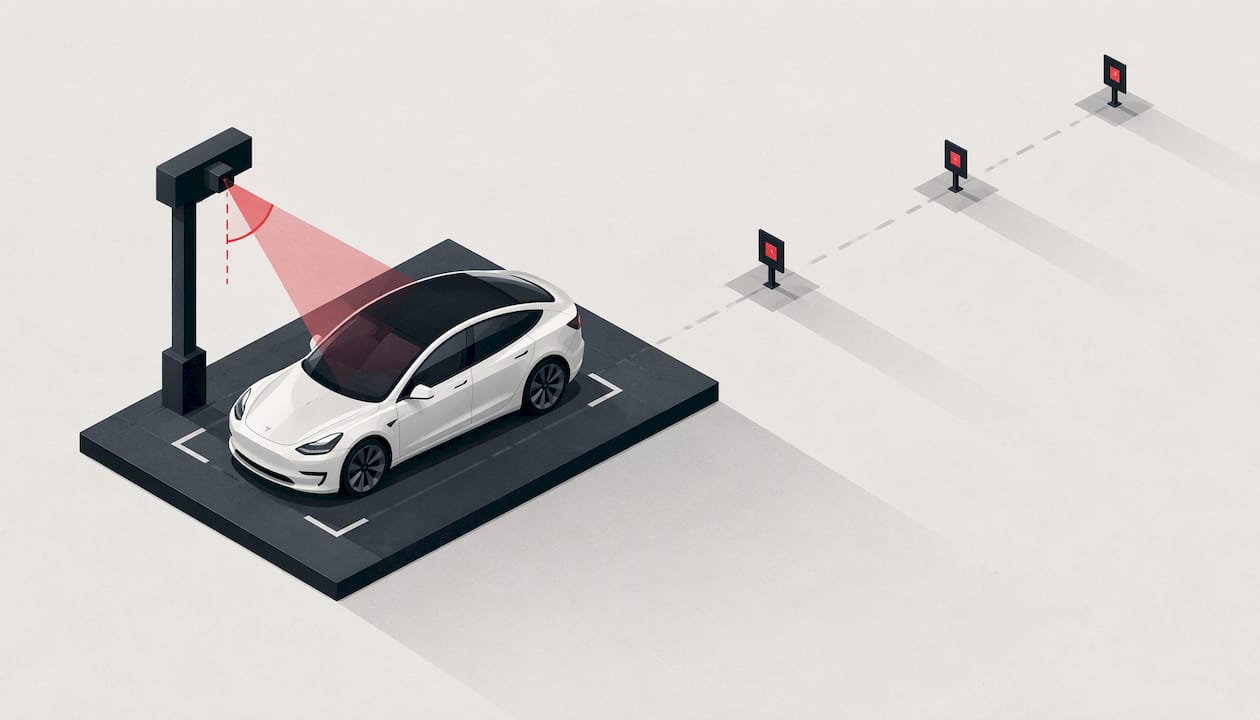
If your Tesla gets a new windshield, its forward cameras have to be calibrated afterward. The cameras sit behind the glass, and Tesla’s own manual says calibration must be cleared when a camera has shifted from its calibrated position, such as after a camera or windshield replacement. Until the cameras relearn their position, some driver-assistance features are unavailable. We do the whole job at your home or workplace in Walnut Creek, Oakley and the surrounding East Bay, with technicians trained for both general auto glass and Tesla and ADAS calibration procedures.
TL;DR
- Every Autopilot-equipped Tesla has forward cameras behind the windshield, so a replacement means clearing and redoing calibration, not just swapping glass.
- Tesla’s service procedures have three parts: clear the old calibration data, let the cameras self-calibrate on the road, and verify the camera pitch.
- Self-calibration typically completes after about 20 to 25 miles of driving, and Tesla asks owners to report it only if it is not done after 100 miles in suitable conditions.
- Until calibration finishes, features such as Lane Departure Avoidance and Automatic Emergency Braking may be unavailable.
- We replace the glass and handle the camera calibration on site, and we handle insurance paperwork at no cost.
Table of Contents
- Why a new windshield affects your Tesla’s cameras
- What the calibration process involves
- How to drive while the cameras calibrate
- What goes wrong when calibration is skipped or rushed
- Let the adhesive cure before you drive
- Does it vary by Tesla model?
- Insurance and what you pay
- Our perspective: calibration is part of the glass job
- Book a mobile Tesla windshield replacement
- FAQ
- Sources
Why a new windshield affects your Tesla’s cameras
A windshield on a Tesla is not only glass. Behind it, near the rearview mirror, sits a housing with the forward-facing cameras, along with a humidity and temperature sensor. When a technician replaces the windshield, the camera assembly has to come off and go back on. Even a tiny change in angle changes what the car thinks it sees: where the lane lines are, how far away the car ahead is, where the edge of the road sits.
Tesla’s Model 3 owner’s manual says that if a camera has moved from its calibrated position, for example after camera or windshield replacement, the calibration must be cleared. It also says some features, including Lane Departure Avoidance and Automatic Emergency Braking, are unavailable until self-calibration completes.
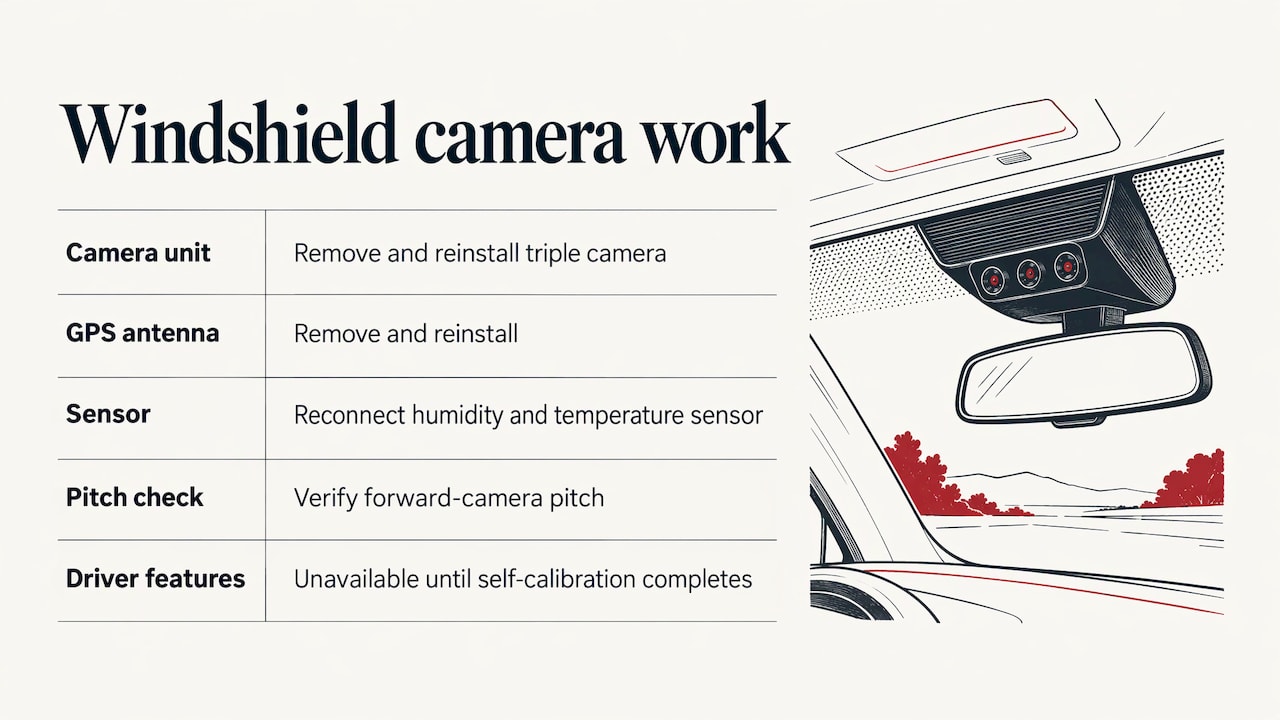
The Tesla body-repair procedure for the Model 3 windshield spells out how involved the work is. It includes removing and reinstalling the forward-facing triple camera and GPS antenna, reconnecting the humidity and temperature sensor, and performing a forward-facing camera pitch verification. It adds that firmware may need updating or reinstalling if a new temperature and humidity sensor goes in.
That is why a Tesla windshield job is different from a typical glass swap. The glass has to seat correctly, the adhesive has to cure, and the electronics behind it have to be put back and checked in the right order.
What the calibration process involves
Tesla’s current service documentation breaks camera work into three distinct steps. Here is what each one means for you.
Step 1: Clearing the old calibration data
The 2025 Model Y service manual says clearing calibration data is required any time an external camera’s position is altered, such as when a camera is reinstalled or replaced. The stated reason is to reduce the risk of unwanted Autopilot behavior. If the old data stays in place, the car keeps using measurements that no longer match where the camera sits.
On newer Model 3 vehicles, the technician does this through Service Mode. The Model 3 2024 and later forward-camera procedure also calls for a camera update routine, available in software 2026.8.6 and later, with a laptop-based procedure before that. The steps differ by model and software version, which is one reason it matters that the person doing the job knows the specific procedure for your car.
Step 2: Pitch verification
Pitch is the up-and-down tilt of the forward camera. After a windshield replacement, Tesla’s procedures call for verifying that the camera’s orientation is correct. On the older Model S, the windshield procedure distinguishes by hardware: first-generation Autopilot uses target calibration, while second-generation uses pitch verification. It warns that Autopilot features might be reduced if pitch is not verified.
The Model X procedure for second-generation or later hardware says the same: clear the calibration and verify pitch, with a caution about reduced Autopilot features if it is skipped. Verification is the step that confirms the camera is aimed correctly before the car starts learning from the road.
Step 3: Self-calibration on the road
After the clear and the pitch check, the cameras learn their position by driving. Tesla’s service manuals tell technicians to let the customer know that self-calibration can take up to 100 miles (160 km) of manual driving, and that Autopilot is limited until it finishes. The touchscreen shows a progress indicator, and a message appears if you try to use a feature that is not yet available.
The owner’s manual gives a more typical figure: calibration usually completes after about 20 to 25 miles (32 to 40 km), depending on road and environmental conditions. It should be reported to Tesla only if it has not finished after 100 miles in suitable conditions.
How to drive while the cameras calibrate
The manual describes the ideal conditions for self-calibration: a straight, multi-lane road, such as a controlled-access highway, with highly visible lane markings in your lane and the lanes beside it, at least two lanes over on each side. The best case is the middle lane of a five-lane highway with minimal traffic.
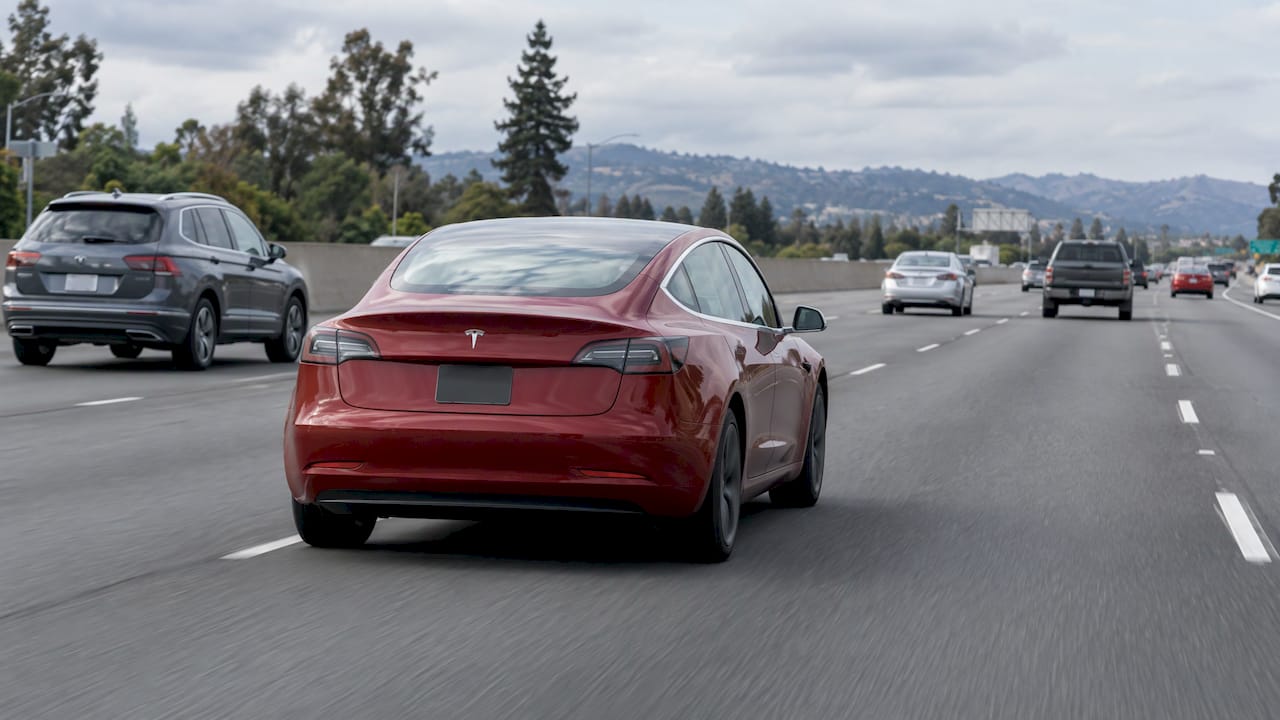
In the East Bay, that means a stretch of freeway with clean, bright markings and light traffic. Midday outside commute hours tends to be easier than the crawl on I-680 or Highway 4 at rush hour. Dim, worn or faded lane lines slow things down, and so do heavy rain and glare.
A few practical points while the progress indicator runs:
- Drive manually. Do not count on Autopilot or Full Self-Driving to help until the display says the cameras are calibrated.
- Expect certain safety features to be unavailable. Lane Departure Avoidance and Automatic Emergency Braking are the two Tesla names in the manual, so allow extra following distance and stay attentive.
- Watch the touchscreen. The progress indicator tells you where you are, and a message appears if you try to use something that is not ready.
- Reach out to us or Tesla if the process has not completed after 100 miles in good conditions.
What goes wrong when calibration is skipped or rushed
Skipped calibration is the most common reason a Tesla feels off after a glass job. One owner report in the search results described the car driving too far to the right side of the lane after a windshield replacement where the calibration was never reset. Tesla’s service manual language matches that concern: clearing calibration exists specifically to reduce the risk of unwanted Autopilot behavior.
The symptoms to know about:
- Autopilot or lane-keeping that sits off-center in the lane.
- Safety features that stay unavailable well past the expected drive distance.
- Warnings on the touchscreen about camera calibration.
If you notice any of these after a windshield job, the fix is to have the calibration redone properly. That is also why we do the calibration as part of the same visit, rather than leaving you to sort it out afterward.
One safety point that has nothing to do with calibration: do not drive a Tesla with a crack that blocks your view, glass that is shattered or sagging, or damage in the camera area behind the mirror. Get it looked at first.
Let the adhesive cure before you drive
The glass is held in by urethane adhesive, and it needs time to set. Tesla’s older Model S procedure names a specific product, with a minimum drive-away time of one hour at 0°F or warmer, and advises avoiding high speeds and speed bumps for 24 hours. Your own car’s cure time depends on the adhesive used and the weather. Ask your technician for the drive-away time on your job and plan your calibration drive after that window.
This is another reason mobile service suits Tesla owners: the car stays parked at your home or office while the adhesive sets, and you pick the time to take that first drive.
Does it vary by Tesla model?
Yes. The broad approach is the same, but the details differ.
| Model and hardware | What Tesla’s procedure calls for |
|---|---|
| Model 3, 2024 and later | Clear calibration, camera update routine, forward-camera pitch verification, then up to 100 miles of manual driving to self-calibrate |
| Model Y (2025 manual) | Clear calibration data, calibrate cameras by driving, pitch verification for some cameras after replacement |
| Model S, 2012 to 2020 | Pitch verification or target calibration depending on Autopilot generation, plus adhesive drive-away time |
| Model X, second-generation Autopilot or later | Clear calibration via the touchscreen service menu, forward-camera pitch verification |
| Model S, HW4 bi-camera | Clear calibration, camera update in Service Mode, pitch verification, up to 100 miles of self-calibration |
The HW4 Model S procedure also notes that an Autopilot-unavailable message appears if Autopilot is engaged too early, per Tesla’s service documentation. Tesla revises these procedures regularly, with several entries updated through 2026, so the right method for your car depends on its year, hardware and software. Our technicians are trained for Tesla and ADAS procedures specifically.
Insurance and what you pay
Many drivers pay little or nothing out of pocket when the replacement goes through insurance. We work with major insurance providers and handle the paperwork at no cost to you. Our step-by-step guide to filing a windshield insurance claim walks through what to expect.
For a small chip, repair is often the better move, because catching damage early can avoid a full replacement and the calibration that comes with it. Our windshield chip and crack repair is $125. Our page on windshield repair versus replacement explains how to tell which one your damage calls for.
Windshield replacement and ADAS calibration pricing depends on your model and your coverage, so we quote it for your specific car. If you have a written quote from another provider, our price-match guarantee applies to written competitor quotes. For a broader look at what calibration usually costs here, see our ADAS calibration cost guide for California.
Our perspective: calibration is part of the glass job
We think of a Tesla windshield replacement as two jobs that have to finish together: the glass and the cameras behind it. A windshield that looks perfect but leaves the forward cameras uncalibrated has not finished the repair.
That is why we do the work where you are. A Tesla owner should not have to choose between a car sitting in a shop and driving around with safety features switched off. Our technicians are certified and trained in both general auto glass repair and the specialized Tesla and ADAS calibration procedures, so the glass, the camera reinstallation and the calibration are handled by the same team.
We use OEM-equivalent or factory glass, we back our work with a lifetime warranty on materials and labor, and we handle the insurance paperwork at no cost. We also do the calibration after the replacement, at your home or workplace, for all makes and models including Tesla.
AutoRenu 911
Book a mobile Tesla windshield replacement
If your Tesla needs a new windshield, we come to your driveway or parking lot in Walnut Creek, Oakley and the East Bay, replace the glass, and take care of the camera calibration. Our Tesla and EV windshield specialist service is listed on our services page, and you can read more about mobile ADAS recalibration in the East Bay. We are rated 4.9 stars from 151 reviews.

Businesses with Tesla fleet vehicles can book on-site service too, so vehicles are repaired where they are parked.
FAQ
Does a Tesla need calibration after a windshield replacement?
Yes. The forward cameras sit behind the windshield, and Tesla’s manual says calibration must be cleared when a camera has shifted, including after windshield replacement. Until self-calibration completes, features such as Lane Departure Avoidance and Automatic Emergency Braking may be unavailable.
How long does Tesla camera calibration take?
Tesla’s owner’s manual says it typically completes after about 20 to 25 miles of driving, though road and weather conditions affect it. Tesla’s service manuals tell technicians to let customers know it can take up to 100 miles. A straight, multi-lane road with clear lane markings works best.
How do I know when the calibration is finished?
The touchscreen shows a progress indicator while the cameras calibrate, and a message appears if you try to use a feature that is not yet available. Once the indicator completes, the features return. If it has not finished after 100 miles in suitable conditions, contact us or Tesla.
Can you do Tesla windshield calibration at my home in Oakley or Walnut Creek?
Yes. We perform our services at your location, including ADAS camera calibration after windshield replacement for all makes and models, Tesla included. We serve Walnut Creek, Oakley and the surrounding East Bay.
Will insurance cover the replacement?
Many customers pay little or nothing out of pocket, depending on their policy. We work with major insurance providers and handle the claim paperwork at no cost. Your deductible and coverage depend on your own policy.
Sources
- Tesla Model 3 owner’s manual: Cameras
- Tesla Model Y 2025 service manual: Vehicle Cameras and Autopilot
- Tesla Model 3 2024+ service manual: Camera, Forward Facing
- Tesla Model 3 body repair: Windshield
- Tesla Model S service manual: Windshield (Remove and Install)
- Tesla Model X service manual: Windshield
- Tesla Model S service manual: Camera, Bi Forward Facing (HW4)