Cracked Windshield Law in Walnut Creek: What California Requires
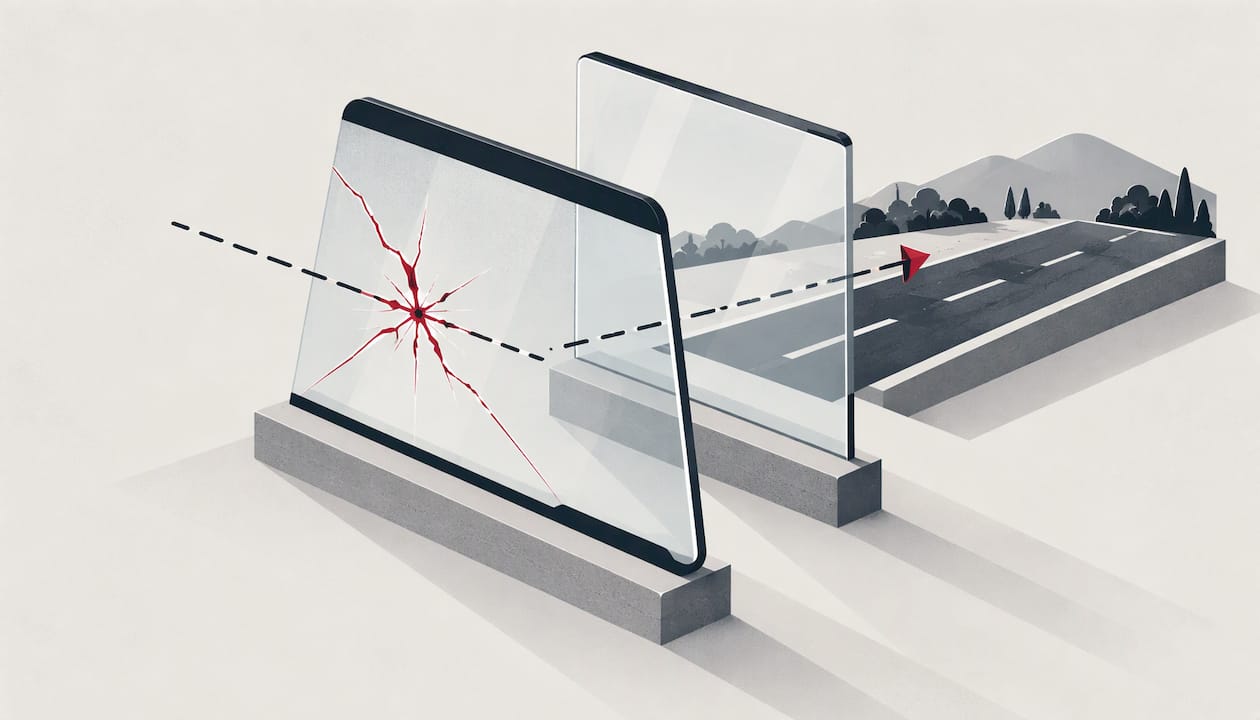
Yes, you can be ticketed for driving with a cracked windshield in Walnut Creek. California has no rule that says “a crack longer than X inches is illegal.” The test is whether the damage impairs your vision, and the officer who stops you makes that call. The safest answer is to repair a chip while it is small and replace the glass when a crack reaches your line of sight. We do both at your home or workplace, so you never have to drive on a damaged windshield to a shop.
TL;DR
- California Vehicle Code 26710 makes it unlawful to drive when the windshield or rear window is so defective that it impairs your vision to the front or rear.
- The statute sets no maximum crack length. The quarter-size and six-inch rules you see online are industry habits, not law.
- An officer who cites you must direct you to correct the problem within 48 hours, and you may be required to show in court that the glass was fixed.
- A crack in the driver’s line of sight is the most likely to draw a citation, and it also fails a state vehicle safety inspection.
- Chips repaired early cost far less than a replacement. Our chip repair is $125 cash, and many insurance policies cover it at no cost to you.
Table of Contents
- What California law actually says
- The quarter and six-inch rules are not law
- Why a crack matters beyond the ticket
- What happens if you get a ticket
- Chip, crack or replacement: how to decide
- If your car has driver-assistance cameras
- What to do the day you notice damage
- Businesses and fleets
- Perspective
- Get it fixed without losing a day
- FAQ
- Sources
What California law actually says
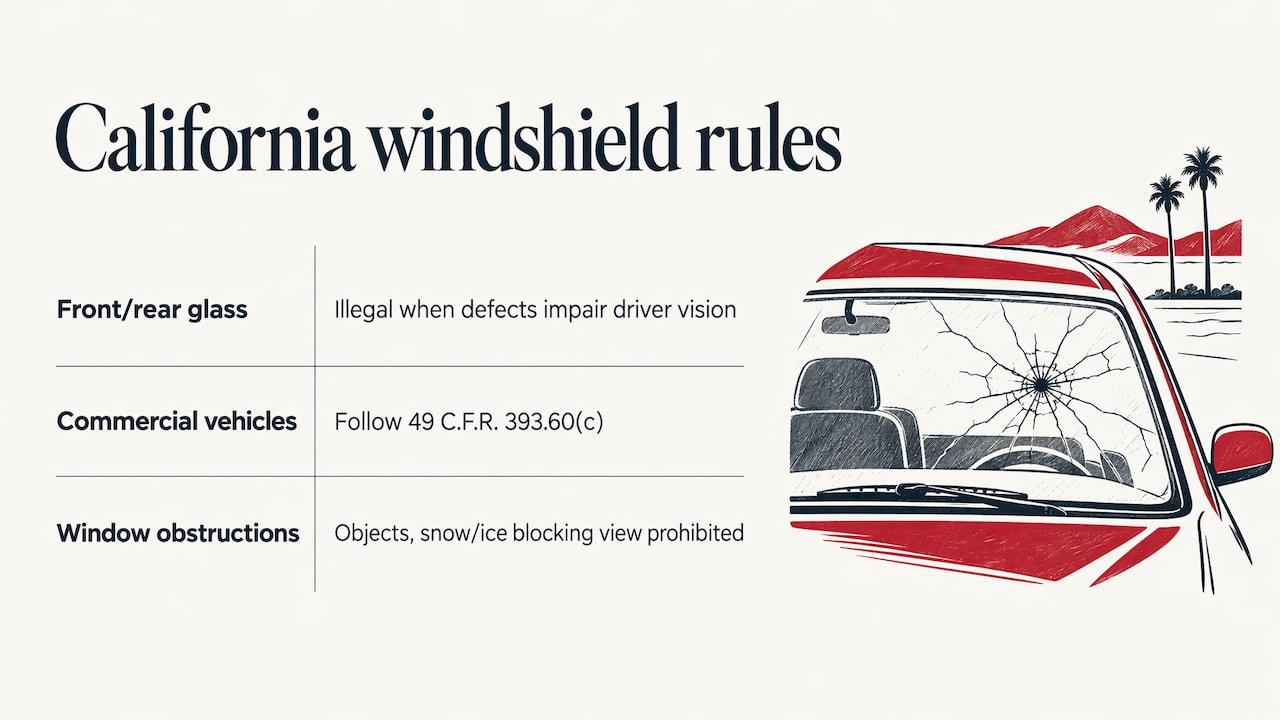
The main rule is Vehicle Code section 26710. Subsection (a) says it is unlawful to operate a motor vehicle on a highway when the windshield or rear window is so defective that it impairs the driver’s vision to the front or rear. The current wording took effect on January 1, 2023.
Three things follow from that sentence.
It is about vision, not measurements. The statute does not mention inches, chip counts or crack types. A short crack right in front of the steering wheel can be a problem. A long crack low on the passenger side may never be. The officer judges what you can see through, which gives them discretion.
It covers the rear window too. A shattered or heavily cracked back glass counts the same way.
Commercial vehicles have a stricter standard. For vehicles described in Vehicle Code section 34500, which includes many trucks and buses, subsection (b) ties the rule to the federal windshield standard in 49 C.F.R. 393.60©. If you manage a work fleet in Walnut Creek, your vans and trucks may fall under that stricter rule.
The obstruction rules are separate. Vehicle Code section 26708, as amended effective January 1, 2026, prohibits driving with objects or materials on the windshield or side or rear windows, or with anything that obstructs or reduces your clear view. It also covers snow or ice blocking your view. Stickers and dash-mounted items can bring a ticket even when your glass is perfect.
The quarter and six-inch rules are not law
You will hear that a chip smaller than a quarter or a crack shorter than six inches is fine. Those figures come from how repair shops decide whether a chip can be filled with resin. They are useful for that purpose, and we use that kind of judgment when we inspect your glass. They are not in the Vehicle Code.
That cuts both ways. A small crack can still earn a ticket if it sits where you look through the glass. And a larger crack outside your driving view is less likely to, though it still weakens the glass.
Why a crack matters beyond the ticket
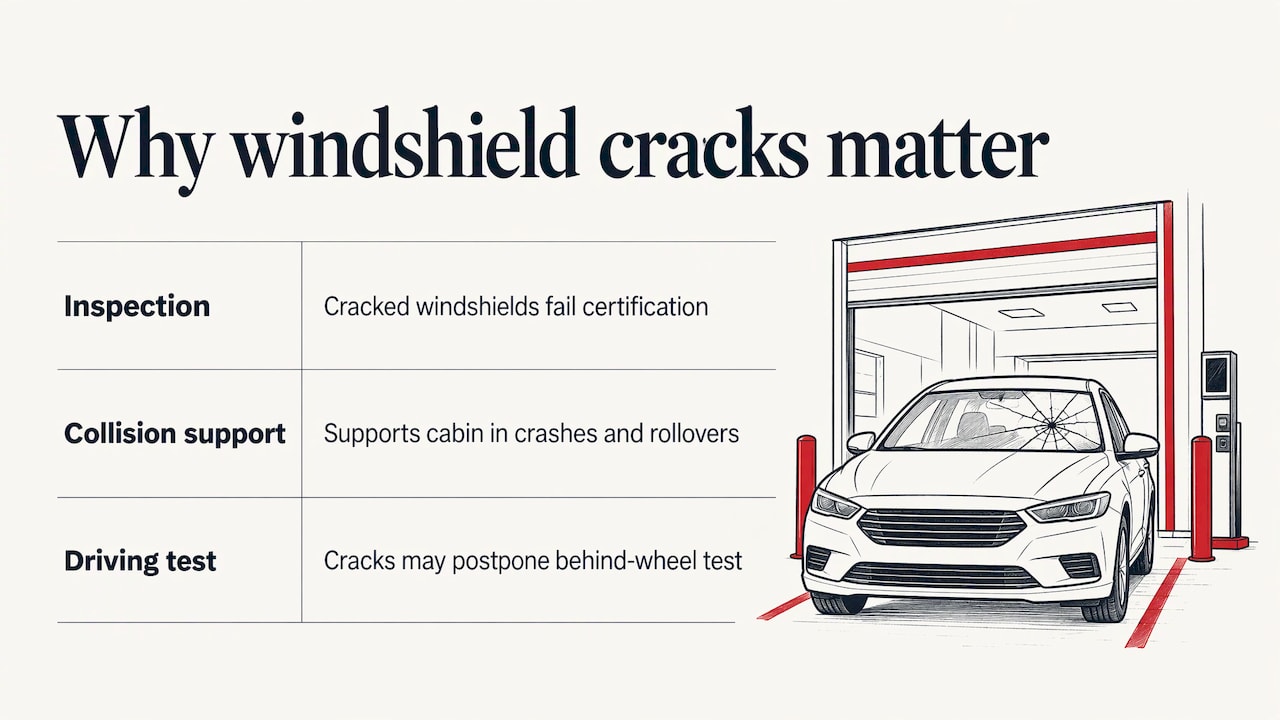
The state’s own inspection rules treat any crack as a problem. The Bureau of Automotive Repair’s Vehicle Safety Systems Inspection Manual (September 2023) tells inspectors to check that the windshield has no cracks and that your view is not impaired by delamination, surface damage or objects on the glass. Stations are directed not to certify a vehicle with a cracked windshield.
The reason is structural. The manual explains that a windshield helps support the passenger compartment in a front-end collision or rollover. A cracked windshield is weaker at the moment you need it most. So even if an officer would let a small crack slide, the glass is not doing its full job.
There is a driving-test angle too. The California DMV Driver’s Handbook says the windshield must allow a full, clear, unblocked view for you and the examiner during a behind-the-wheel test, and that windshield cracks may postpone the test. If a family member is about to test at the Walnut Creek DMV, fix the glass beforehand.
What happens if you get a ticket
Here is the sequence under section 26710, in plain terms.
- The officer directs correction. The statute says the officer must direct you to make the windshield or rear window conform within 48 hours.
- The officer may do more. The same section allows the officer to arrest the driver, give a notice to appear, and require the driver or owner to produce satisfactory evidence in court that the glass was made to conform. In everyday practice a ticket with a correction notice is the usual result, but the statute gives the officer the options.
- You prove the fix. Keep your invoice. The court or the agency named on the ticket will tell you how to show that the problem was corrected, so follow the instructions printed on your citation.
The details of fines, fees and deadlines are on your citation and on the court’s page, and they change. Read the notice you receive and follow its deadlines. If you miss them, a correctable ticket can turn into a full penalty, so do not let the paperwork sit.
If you have questions about a specific citation or a court appearance, talk to the court clerk listed on the ticket or a traffic attorney. This article explains the rule, not your particular case.
Chip, crack or replacement: how to decide
The law does not decide this for you, so use practical judgment. Our repair vs. replacement guide goes deeper. The short version:
| What you see | What it usually means | Typical next step |
|---|---|---|
| Small chip, no spreading lines | Early damage, glass still strong | Repair now, before dirt and temperature swings spread it |
| Chip with short cracks coming off it | Damage is starting to grow | Repair soon, as long as it is outside your main view |
| Long crack, or crack across your line of sight | Likely to draw a citation and weaken the glass | Replacement |
| Damage at the edge of the glass | Edge cracks spread quickly | Usually replacement |
| Many chips or pitting from highway debris | Glass can scatter light and glare | Replacement if it affects your view |
A chip repair fills the damaged spot with resin, which stops it from spreading and restores much of the clarity. It works best when you act quickly. Our chip and crack repair is a mobile job, and our chip repair is $125 as a cash price. Many insurance policies cover chip repair at no cost to you, and we handle the insurance paperwork at no charge. See the Walnut Creek chip repair page for details.
Walnut Creek drivers have a particular reason to act fast. Daily commutes on I-680 and Highway 24 mean gravel and debris, and the East Bay’s temperature swings between cool mornings and hot afternoons make a small chip grow into a crack. A chip you ignore in October can be a crack across your view by the time summer heat arrives.
If your car has driver-assistance cameras
Most newer cars, and every Tesla, mount a forward camera behind the windshield. It supports lane-keeping, automatic emergency braking and adaptive cruise control. Replace the glass and that camera needs to be recalibrated, so it sees the road accurately again.
This is where mobile service helps. Our technicians are certified and trained for both general auto glass work and Tesla and ADAS camera calibration procedures, and we do the calibration on site. You can read about it on our ADAS recalibration page. Our Tesla and EV windshield service is also listed on our services page.
What to do the day you notice damage
- Look at where it is. Sit in the driver’s seat and see whether the damage falls in the area you look through. If it does, treat it as urgent.
- Keep it clean and dry. Do not pick at a chip, and avoid blasting the glass with a pressure washer or hot defroster.
- Remove anything obstructing the view. Under section 26708, objects on the glass can bring a ticket on their own.
- Call your insurer or call us. Many policies cover chip repair, and some cover replacement. We work with major insurance providers and handle the claim paperwork at no cost, so many customers pay little or nothing out of pocket.
- Book a mobile visit. We come to your home or workplace, so you do not have to drive a damaged windshield to a shop.
- Keep your invoice. If you were cited, it is your proof of correction.
Businesses and fleets
If you run a business, a cracked windshield on a work vehicle is a compliance issue as well as a safety one. For vehicles in the commercial category, the standard references the federal rule mentioned above. Mobile service lets your drivers stay on the job while the glass is repaired at your location. We serve business customers on site across Walnut Creek and the East Bay.
Perspective
Most people come to us after an officer, a family member or a failed inspection has pointed at a crack. They ask how big a crack is allowed. The honest answer is that California does not use a size limit. It asks whether you can see clearly, and that judgment belongs to whoever stops you.
So we tell drivers to think about timing, not thresholds. A chip is the cheapest and fastest fix, and our repair is a short mobile visit. Once a crack grows into your view, replacement is the right call, and that is where the details matter: glass that matches the original specification, and for cars with cameras, a proper calibration afterward.
We built our service around making that easy. Our technicians come to you, we use OEM-equivalent glass, we handle insurance paperwork at no cost, and our work carries a lifetime warranty on materials and labor. We also offer a price-match guarantee against written competitor quotes. Our customers rate us 4.9 stars across 151 reviews.
AutoRenu 911
Get it fixed without losing a day
If you have a chip, a crack or a ticket to clear, we will come to you in Walnut Creek, Oakley or elsewhere in the East Bay. Chip repair is $125 cash, and many customers pay nothing when their insurance covers it. For a crack that needs replacement, see our Walnut Creek windshield replacement page, or browse everything we do on our services page.

If you drive in Oakley, our guide to the cracked windshield law in Oakley covers the same state rule for that city. For a longer walk through the statute, see our explainer on driving with a cracked windshield in California.
FAQ
Can you get a ticket for a cracked windshield in California?
Yes. Vehicle Code section 26710 makes it unlawful to drive when the windshield or rear window is so defective that it impairs your vision. The officer must direct you to correct the problem within 48 hours and may also require proof in court that the glass was fixed.
Is there a legal limit on crack length in California?
Not for ordinary passenger vehicles. The statute asks whether the defect impairs the driver’s vision rather than measuring the crack. Commercial vehicles described in section 34500 are tied to the federal windshield standard in 49 C.F.R. 393.60©.
Can a long crack in a windshield be repaired?
It depends on the length, the position and whether it reaches the edge. Short cracks and chips outside the driver’s main view can often be repaired with resin. Long cracks or damage across your line of sight usually call for replacement. We can look at it and tell you which applies.
Will a cracked windshield stop me from passing a vehicle safety inspection?
It can. The Bureau of Automotive Repair’s inspection manual tells inspectors to confirm there are no cracks in the windshield and directs stations not to certify a vehicle with a cracked windshield.
How much does it cost to fix a rock chip in Walnut Creek?
Our chip and crack repair is $125 as a cash price. If your insurance covers it, many customers pay nothing out of pocket, and we handle the paperwork at no cost.
Sources
- California Vehicle Code section 26710
- California Vehicle Code, including section 26708 as amended for 2026
- Bureau of Automotive Repair, Vehicle Safety Systems Inspection Manual
- California DMV Driver’s Handbook