Commercial Vehicle Wraps: Planning, Rules and Care
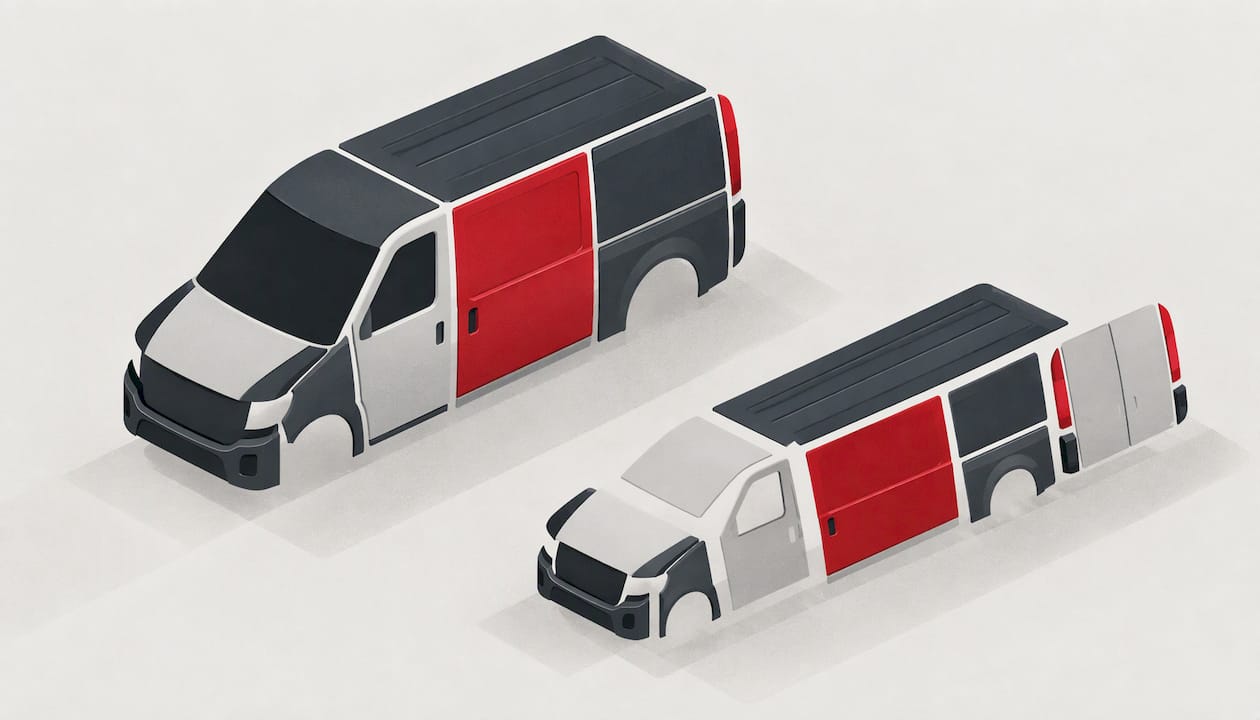
A commercial vehicle wrap is printed vinyl film applied over a van, truck or car so the vehicle advertises your business wherever it parks or drives. The wrap itself is only one part of the job. A good result depends on the coverage you choose, the film, a design that reads at speed, the markings your vehicle must keep legible, and the condition of the glass and paint the film sits against. We are AutoRenu 911, a mobile auto glass and vehicle film service in Walnut Creek, Oakley and the East Bay, and we do car wraps and paint protection film at your location, so you can plan the wrap, the glass and the film work as one visit instead of one more trip to a shop.
TL;DR
- A wrap is printed film over your paint. Full wraps, partial wraps and lettering use similar materials; the difference is how much of the vehicle they cover and how the design uses the vehicle’s own color.
- Fleet-grade cast film, a protective laminate and a design built for distance reading do most of the work of making a wrap last and sell.
- Vehicles that cross state lines at 10,001 lbs or more must keep the USDOT number legible on both sides. Opaque film does not belong on the windshield or front side windows.
- Fix glass damage before the wrap goes on, so you never have to work around new vinyl later.
- We handle wraps, windshield replacement, chip repair and ADAS camera calibration at your home, yard or workplace.
Table of Contents
- What counts as a commercial vehicle wrap
- Choosing coverage for a van, pickup or small fleet
- Film and finish: what you are actually buying
- Design that works at 45 miles per hour
- Legal markings and what must stay uncovered
- Do the glass work before the wrap
- Installation: what a clean job takes
- Care, repair and removal
- Our perspective
- Wraps and glass from one mobile team
- FAQ
- Sources
What counts as a commercial vehicle wrap
A wrap is pressure-sensitive vinyl, printed with your graphics, laminated and heat-applied so it follows the curves of the panels. It sits on top of the factory paint and does not replace it. Three coverage levels cover most business needs.
Full wrap. The graphics run across most of the visible exterior and the vehicle becomes a moving billboard. “Full” does not automatically mean every surface: roofs, bumpers, mirrors, trim, door jambs and windows are often left out, so ask for a written coverage map by panel before you approve a quote.
Partial wrap. Connected graphics cover selected panels, usually the sides, rear or hood, and the factory paint color becomes part of the design. A partial wrap works best when the artwork is designed around the unwrapped areas, not stretched over them. For a white van with a white body, a bold lower-half graphic and a clean logo can carry the whole brand.
Lettering and spot graphics. Cut vinyl or small printed pieces carry a name, a phone number or a door logo. This is the lowest-effort way to get a vehicle identified, and it is the right starting point for a single work truck or a service car.
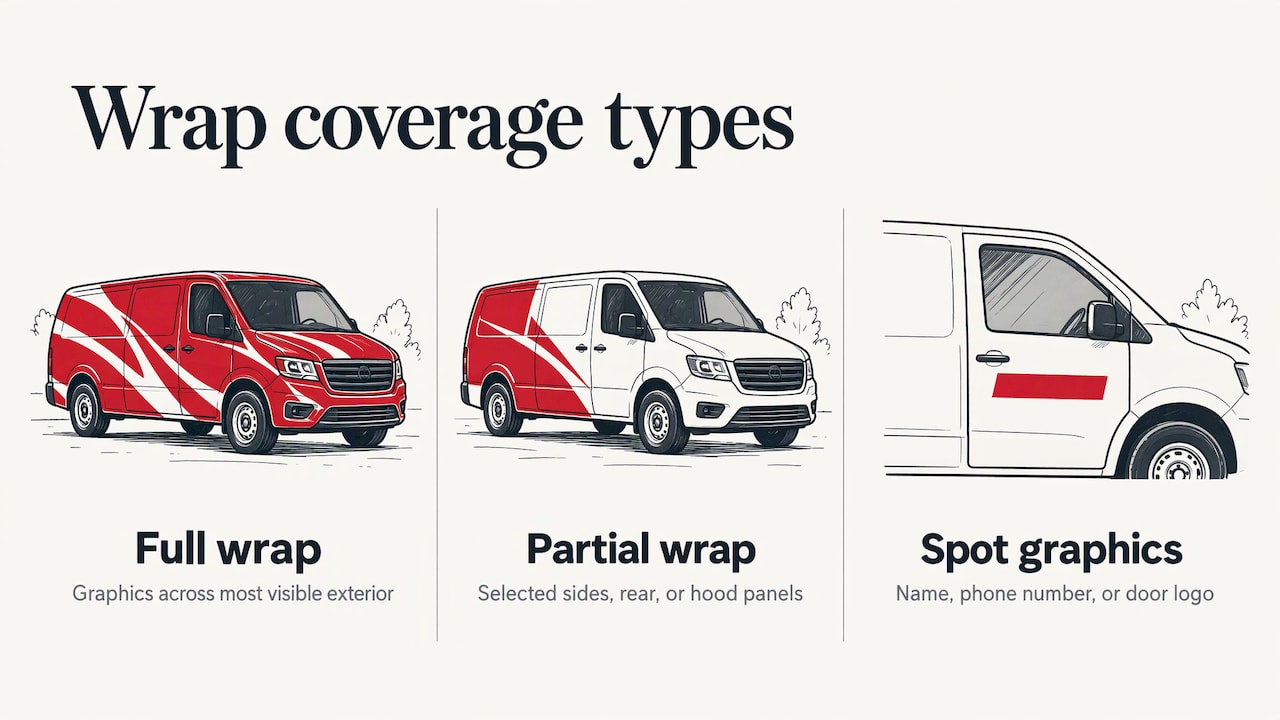
The film manufacturers publish their own range. Avery Dennison’s fleet graphics page lists full fleet wraps, partial wraps on large flat sections such as a hood, door or tailgate, full reflective wraps, reflective decals, DOT-C2 conspicuity tapes and cut-vinyl spot graphics. That range shows how much room you have between a simple door logo and a head-to-toe wrap.
Choosing coverage for a van, pickup or small fleet
Coverage is a business decision before it is a design decision. Start with four questions:
- How long will the vehicle stay in service? A van you plan to keep for five years justifies more film than a vehicle you will replace next year.
- Where does it spend its day? A vehicle parked at job sites for hours earns impressions from a rear and side wrap. A vehicle on the freeway is seen mostly from behind and the sides.
- What color is the vehicle already? A light, clean factory color is a design asset in a partial wrap. A faded or patchy finish is a reason to consider fuller coverage.
- Do all vehicles need the same layout? Rarely. A pickup, a cargo van and a box truck have different panels. The goal is one recognizable brand across the fleet, not identical artwork stretched onto every body.
For a fleet, decide on the brand system first (logo files, exact brand colors, one typeface family), then adapt it to each vehicle family. If you own a few vans and a couple of pickups, you will end up with two or three layouts that clearly belong together.
We cover the planning side of fleets in more detail in our guide to fleet vehicle wraps.
Film and finish: what you are actually buying
Two families of vinyl matter for vehicles. Cast film is made to conform around curves and rivets and is the usual choice for full wraps of vans and trucks. Calendered film is stiffer and suits flat or simple surfaces, such as lettering on a flat door panel. For a wrap that must stretch over a bumper or a corrugated van door, cast film is the one to ask for.
3M’s guidance for fleet buyers frames the choice around five factors: durability, installation efficiency, maintenance, ease of removal and warranty. Two of those are easy to overlook when you compare quotes. Films with good air release and repositionability go on with fewer bubbles, which shortens the time a vehicle is out of service. High-quality films also come off cleanly within the recommended timeframe, which protects the paint when you rebrand or sell the vehicle.
Finish changes the look and the upkeep. Gloss reads as bright and clean from a distance. Matte gives a more understated, premium look but shows different maintenance habits; our matte wrap guide covers finish, cost and care in detail.
Design that works at 45 miles per hour
Most bad wraps fail for one reason: they were designed for a screen, not a roadway. Plan the artwork with these rules:
- Lead with the business name. Then one primary service, then one way to reach you. Every extra phone number, address or service list competes with the one that matters.
- Size for distance. The name should read from far away, and the phone number or website from a car length or two. If you can only fit one contact method, choose the one customers actually use.
- Use strong contrast and a clean sans-serif typeface. Thin script fonts and low-contrast color pairs disappear at speed.
- Keep the brand files exact. Supply vector logos and specified brand colors. Colors on a monitor will not exactly match printed vinyl, so ask for a printed swatch before production.
- Leave space for required markings. Fit the legal copy into the design from the start, not as an afterthought on the door.
- Work from the right template. Professional designers use a template of the exact make, model and roof height, with door seams and body lines marked, and a typical project includes a couple of revision rounds. Confirm the number in your quote.
A wrap installer should measure and photograph every side of each vehicle before artwork is final. If a quote skips that step on a vehicle with an unusual body, such as a high-roof van or a utility body, expect surprises at installation.
Legal markings and what must stay uncovered
A wrap does not cancel your regulatory markings. Two rules cover most small businesses in California.
USDOT markings. For interstate vehicles with a gross vehicle weight rating or combined rating of 10,001 pounds or more, 49 CFR 390.21 requires the carrier’s name and USDOT number on the vehicle. The letters must be readily legible in daylight from 50 feet while the vehicle is stationary, and they must stay that way. Wrap artwork that buries the number in a busy pattern or wraps it around a panel edge creates a problem. Have the designer put the number on a clean, high-contrast block on both sides. If you run intrastate in California, check which markings apply to your operation with the carrier authority that issued your numbers.
Glass. California’s Vehicle Code section 26708 limits materials that can be placed on the windshield and the front side windows. Practically, keep opaque or heavily tinted film off the windshield and the driver and front passenger windows. Rear glass perforated graphics and dark tint on rear windows are separate questions with their own rules, so confirm your exact layout before ordering. Required lights and reflectors must stay uncovered as well.
Do the glass work before the wrap
This is the step most wrap guides skip. A wrap that touches the glass, or a vehicle that will have a cracked windshield soon, creates avoidable problems.
Cracked or chipped windshield. Replace or repair it before the wrap goes on. A replacement involves removing and resetting the glass, with the trim and moldings around it, and you want that done while the body panels around the glass are clean and unwrapped. Our guide to how long windshield replacement takes lays out the timeline so you can schedule the sequence.
Camera and sensor systems. Many work vans and pickups carry forward-facing cameras behind the windshield. After a windshield replacement those cameras need ADAS calibration. We do this on-site, for all makes and models including Tesla. See our page on ADAS camera calibration.
Vans. If your fleet runs cargo vans, our van windshield replacement guide covers cost, time and mobile service for that glass.
Fleets. When several vehicles need glass and film at once, a plan beats ad hoc repairs. Our fleet windshield replacement guide is written for East Bay fleet managers.
A small chip is the easiest fix. Chip and crack repair is listed on our services page at $125, and many customers pay little or nothing out of pocket when insurance covers it.
Installation: what a clean job takes
A wrap installer prepares the surface first. Paint must be clean, intact and well bonded. Any loose clear coat, rust or old adhesive shows through the film or lifts it. Panels are cleaned, hardware such as handles and badges is managed, and film is laid, heat-formed and trimmed around edges, seams and recesses.
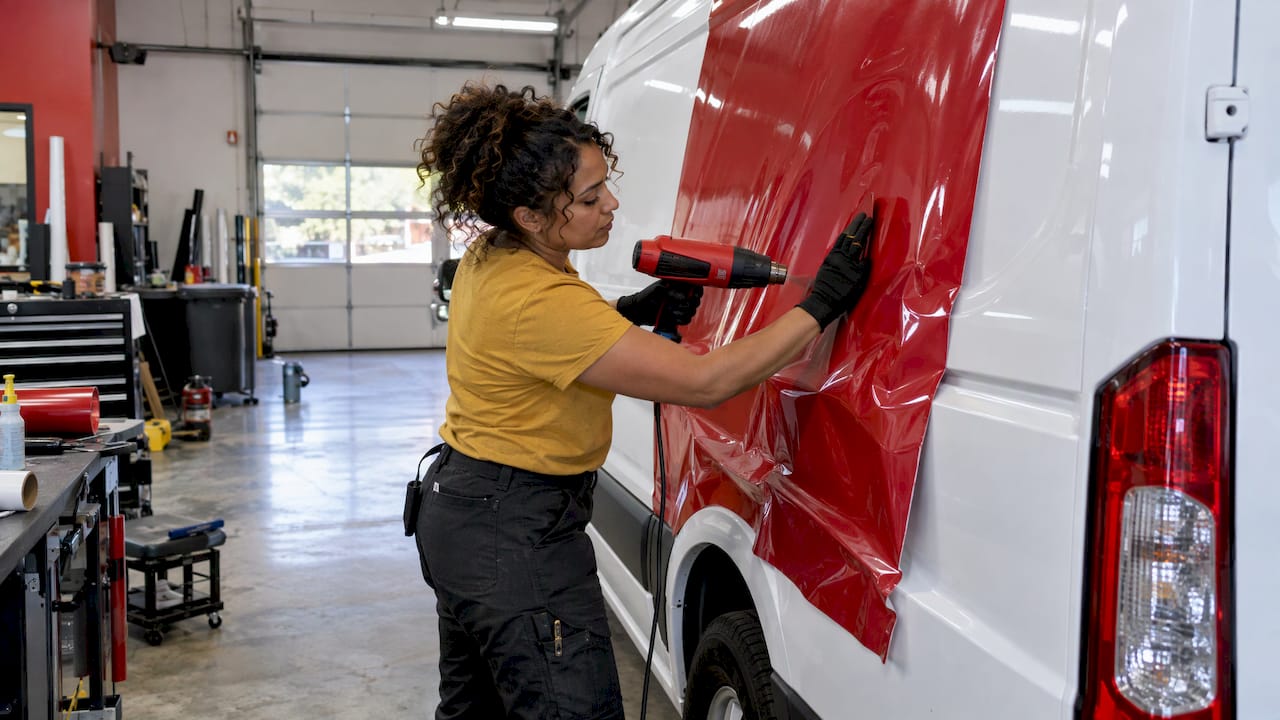
Time depends on the vehicle and how much of it is covered. Lettering is quick. Partial wraps on a standard van or pickup are generally shorter jobs than full wraps, and a full wrap on a large van is a multi-day project for a skilled installer. Fleets add scheduling: identical vehicles can run back to back, but each one is still out of service while it is being wrapped. Plan rotations so you never lose the whole fleet at once.
Because we work at your location, the vehicle does not have to leave your property for a trip to a shop. For a business, that means less unpaid driving time and fewer gaps in the schedule. Confirm scope and timing for your vehicles by contacting us from the home page.
Care, repair and removal
A wrap lasts longest when it is cared for like a finish, not ignored like a tarp.
- Wash it regularly. 3M states that graphic films can be cleaned by hand, pressure wash or an automated wash, and that contamination left on the film becomes harder to remove. Fleet vehicles collect road film, bird droppings and fuel splashes, so wash on a schedule.
- Give new film time. Let the adhesive set before the first wash. Your installer will tell you how long for the film they used.
- Park covered when you can. Sun and heat are the main enemy of printed film, and horizontal surfaces like hoods and roofs take the worst of it. Manufacturer warranties for horizontal surfaces are shorter than for vertical panels for exactly that reason.
- Walk the vehicle weekly. Look for lifted edges, bubbles and scrapes. Small damage is easier to fix early.
- Replace panels, not whole graphics. 3M notes that panels damaged by normal roadway wear can typically be replaced individually, so a scraped door does not mean a full reprint.
- Remove on schedule. Removing film within the recommended timeframe keeps the paint safe. Waiting too long can make removal harder and leave adhesive residue.
If you want to protect high-impact areas such as the front bumper, mirror caps or hood, paint protection film is a separate layer designed for that job. Our Tesla paint protection film guide and headlight protection film page show what is typically covered and how it is installed.
Our perspective
We see a wrap as one piece of keeping a work vehicle on the road and looking professional. The film, the glass and the sensors behind the windshield all have to work together, and that is why we handle them together.
Our technicians are certified and trained for general auto glass work and for specialized Tesla and ADAS calibration procedures. We offer car wraps and paint protection film alongside windshield replacement, chip and crack repair, side and rear window replacement, and mobile window tinting. All of it happens at your home or workplace.
For a business, the practical point is simple: one provider, one location, one schedule. When a van needs a new windshield and a new wrap, the order of work matters, and we can plan it with you. We use OEM-equivalent or factory glass, we handle insurance paperwork at no cost, and our work carries a lifetime warranty on materials and labor. If you have a written competitor quote, we also offer a price-match guarantee.
AutoRenu 911
Wraps and glass from one mobile team
If your vehicles need glass work, film work or both, we come to you in Walnut Creek, Oakley and the surrounding East Bay. We offer windshield chip and crack repair at $125, windshield replacement, ADAS camera calibration, side and rear window replacement, mobile window tinting, car wraps and paint protection film. Tesla and EV owners get a dedicated specialist for windshield work.

See everything we offer on our services page, and ask us for a plan for your van, truck or fleet. If window tint is part of your project, our free tint quote page is the quickest way to start.
FAQ
What is the difference between a full wrap, a partial wrap and lettering?
A full wrap covers most of the visible exterior with connected graphics. A partial wrap covers selected panels and uses the vehicle’s own paint color as part of the design. Lettering and spot graphics are cut or small printed pieces for a name, logo or phone number. Ask for coverage by panel so you know exactly what is included.
Does a commercial vehicle wrap need a USDOT number?
The wrap does not, but your vehicle might. Interstate vehicles with a GVWR or GCWR of 10,001 pounds or more must display the carrier name and USDOT number so it is legible from 50 feet in daylight. Put the number on a clear, high-contrast area of the design, and check your own requirement with the authority that issued your numbers.
Can I put a wrap over the windshield or front windows?
No opaque film belongs on the windshield or the front side windows, and California’s Vehicle Code restricts materials there. Wrap graphics normally stop at the glass line on those windows. If you need heat or glare control, ask us about window tinting that fits the rules for each window.
Should I fix a chipped windshield before wrapping the vehicle?
Yes. Repair a chip or replace a cracked windshield first so the glass work happens on clean, unwrapped panels. If your vehicle has a forward camera, ADAS calibration follows a windshield replacement. We do both at your location.
How do I keep a wrap looking good?
Wash it regularly, park in shade when you can, and check it weekly for lifted edges or scrapes. Contamination left on film is harder to remove later. Damaged panels can often be replaced individually, so small problems do not require a full redo.
Sources
- Avery Dennison: Fleet Vehicle Graphics
- 3M: 5 Film Factors for Wrapping Fleets
- eCFR: 49 CFR 390.21, Marking of self-propelled CMVs
- California Legislative Information: Vehicle Code, Windshields and Mirrors